When businesses need capital to purchase equipment, improve cash flow, or support expansion, they often compare traditional bank loans with other corporate financing options. While both can provide the funding needed to grow, they differ in how they are structured, how quickly funds may become available, and the flexibility they offer.
For companies that rely on equipment, inventory, accounts receivable, or other business assets, Corporate Financing can provide an alternative to conventional bank lending without affecting business ownership.
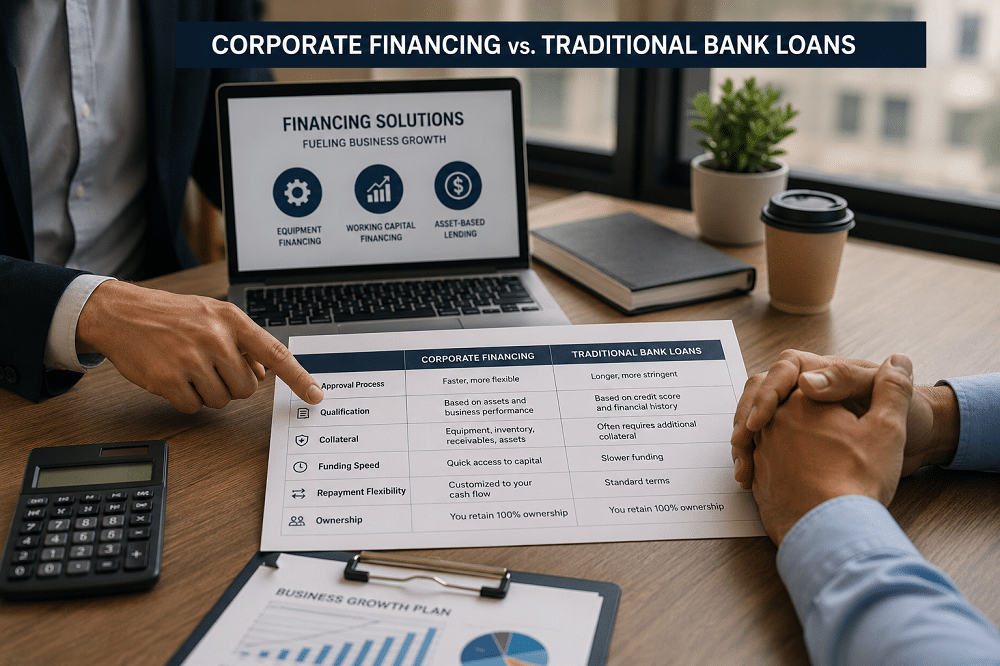
What Is Corporate Financing?
In the context of commercial lending, corporate financing refers to customized funding solutions designed to help businesses acquire equipment, improve liquidity, or finance expansion.
Rather than relying solely on traditional term loans, corporate financing may include solutions such as:
- Asset-based lending
- Equipment financing
- Working capital financing
- Equipment refinancing
- Commercial leasing
- Structured financing based on business assets
Unlike equity financing, these funding options do not require business owners to sell ownership interests or give investors control over company decisions. Instead, financing is typically secured by business assets or supported by the company’s financial strength.
What Are Traditional Bank Loans?
Traditional bank loans are one of the most familiar financing options available to businesses. Banks typically lend a fixed amount that is repaid over a set period with interest.
Before approving a loan, banks often review:
- Business and personal credit history
- Financial statements
- Cash flow
- Years in business
- Available collateral
While bank financing can work well for qualified borrowers, approval requirements may be more restrictive, particularly for companies experiencing rapid growth or those with unique financing needs. In addition to interest and loan payments, banks will often attach covenants to a business loan. Think of these as a set of ground rules that outline how the business must operate until the funds are paid back.
Comparing Corporate Financing and Bank Loans
Although both provide access to capital, there are several important differences.
Approval Process
Traditional banks generally follow standardized underwriting procedures that can require extensive documentation and longer approval timelines.
Corporate financing providers often take a broader view of the business by evaluating the value of equipment, receivables, inventory, and overall business performance. This can create opportunities for companies that may not fit conventional lending requirements.
Financing Flexibility
One of the biggest advantages of corporate financing is flexibility.
Financing structures can often be customized to support:
- Equipment purchases
- Fleet expansion
- Seasonal working capital needs
- Business acquisitions
- Refinancing existing debt
Repayment schedules may also be designed around a company’s operating cycle rather than following rigid loan structures, and without restrictive loan covenants.
Collateral Considerations
Traditional banks frequently require strong collateral along with an established credit history.
Corporate financing often focuses on the value of business assets, including:
- Equipment
- Accounts receivable
- Inventory
- Commercial real estate (when applicable)
Businesses with valuable assets may be able to leverage those resources to obtain financing while preserving operating cash.
Ownership and Control
One important distinction is that corporate financing through asset-based or equipment-backed lending does not change business ownership.
Business owners retain control of their company while using qualifying assets to secure financing. This makes corporate financing an attractive option for companies seeking capital without bringing in outside investors or giving up equity.
When Corporate Financing May Be the Better Choice
Corporate financing may be well-suited for businesses that:
- Need to purchase or upgrade equipment
- Want to preserve working capital
- Have valuable business assets
- Need financing tailored to operational cash flow
- Require flexible financing structures for expansion
For example, a transportation company adding new trucks may choose equipment financing that allows the vehicles themselves to help support the financing while preserving cash for hiring drivers and expanding operations.
Similarly, if an industrial service provider is awarded a new contract and needs additional equipment quickly, they may choose corporate financing to accelerate the process.
When a Traditional Bank Loan Makes Sense
A traditional bank loan may be appropriate when a business:
- Has strong financial statements and established credit
- Needs a straightforward term loan
- Meets conventional lending requirements
- Prefers a standard repayment schedule
For routine capital needs and businesses with long banking relationships, traditional financing can still be an excellent option. Many times, traditional bank financing and corporate financing work in tandem when financing capital expenditures.
Comparing Two Business Scenarios
Example 1: Equipment Expansion
A construction company needs to purchase several pieces of heavy equipment to support new projects. Rather than paying cash or waiting through a lengthy bank approval process, the company secures equipment financing using the equipment purchase as part of the financing structure. This preserves working capital for payroll, fuel, and project expenses.
Example 2: Improving Cash Flow
A manufacturer has significant capital tied up in unpaid customer invoices. Instead of waiting weeks or months for payment, the business can finance existing equipment in a sale-leaseback to unlock working capital, allowing it to purchase raw materials and fulfill additional orders.
Both examples demonstrate how corporate financing can solve operational challenges while supporting continued growth.
Choosing the Right Financing Solution
Every business has unique financing needs. Before selecting a funding solution, consider:
- Current cash flow
- Equipment or asset needs
- Credit profile
- Available collateral
- Growth objectives
- Desired repayment flexibility
Reviewing these factors helps businesses identify financing solutions that support both immediate needs and long-term success.
Finding the Right Funding Strategy
Corporate financing and traditional bank loans both have an important place in business growth. The right choice depends on your company’s financial position, available assets, and long-term objectives.
For businesses looking to finance equipment, improve liquidity, or support expansion without giving up ownership, VFI Corporate Finance offers flexible financing solutions tailored to your operational needs. By evaluating your business goals and available assets, our team can help you identify a financing strategy that supports sustainable growth while preserving financial flexibility.