Expanding a hospitality business across multiple properties can create significant opportunities for revenue growth, but it also requires careful financial planning. Each new location brings expenses for equipment, furnishings, technology, renovations, staffing, and ongoing operations. For businesses managing several properties, the right Hospitality Expansion Financing strategy can help control these costs while maintaining healthy cash flow.
Financing can also help hospitality operators standardize equipment and operational systems across locations. Instead of making large cash purchases for every property, businesses can use structured financing to spread costs over time and preserve working capital for other priorities.
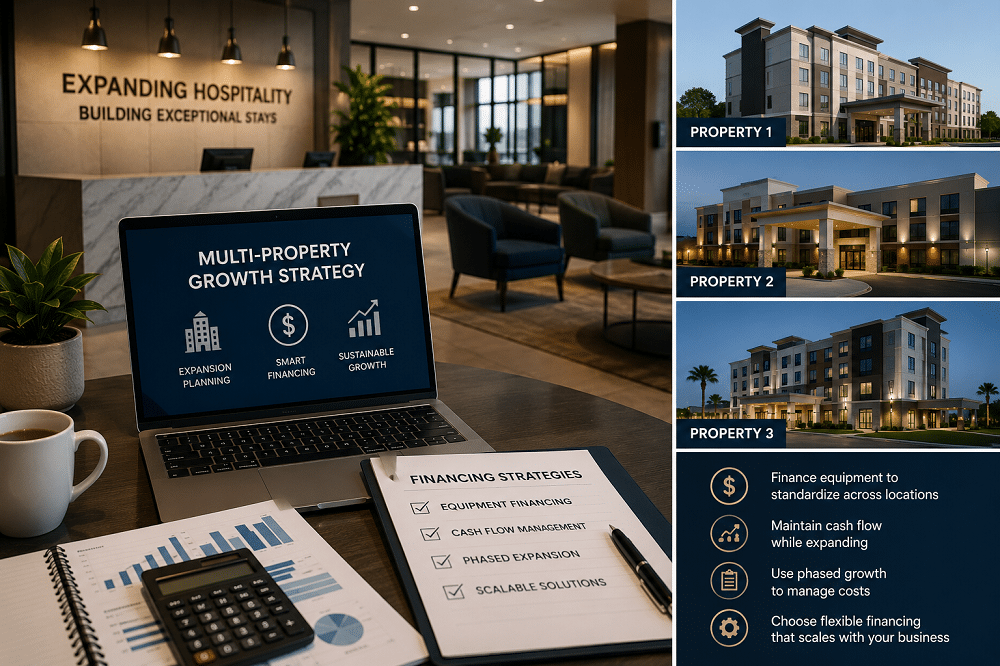
Standardizing Equipment Across Multiple Properties
Consistency is important when operating multiple hospitality locations. Guests expect similar service standards, and employees benefit when equipment and operational systems are familiar from one property to another.
Equipment financing can help businesses acquire standardized assets across locations, including:
- Commercial kitchen equipment
- Laundry equipment
- Refrigeration systems
- HVAC and climate-control equipment
- Point-of-sale technology
- Guest-room furnishings and equipment
- Maintenance and facility equipment
Using financing to standardize equipment can make it easier to plan purchases as properties are added. It can also help businesses avoid draining cash reserves each time a new location opens or an existing property undergoes an upgrade.
Balancing Expansion Costs and Cash Flow
Opening or acquiring another property can require substantial capital before the location begins generating its full revenue potential. Businesses must account for construction, renovations, equipment, furnishings, technology, inventory, payroll, and marketing.
Preserving liquidity during this period is essential. Financing allows businesses to distribute certain acquisition and upgrade costs over time rather than paying the entire expense up front.
Maintaining working capital can provide greater flexibility for:
- Staffing new properties
- Purchasing inventory and supplies
- Marketing new locations
- Handling unexpected operating costs
- Funding future improvements
- Managing seasonal fluctuations
A financing strategy should therefore consider more than the purchase price of equipment. The goal is to structure payments in a way that supports the broader financial needs of the hospitality business.
Using a Phased Approach to Property Growth
Multi-property expansion does not necessarily have to happen all at once. A phased approach can help businesses manage capital requirements and evaluate performance before committing to additional locations.
For example, a hospitality company might first acquire or renovate one property, establish operational systems, and monitor revenue performance. Once the location reaches targeted performance levels, the business can use the experience and financial data from that property to guide the next phase of expansion.
Financing can complement this approach by allowing businesses to spread equipment and improvement costs across each phase.
A phased strategy may involve:
- Evaluating the financial performance of the existing property.
- Identifying equipment and infrastructure requirements for the next location.
- Establishing a financing structure for the planned investment.
- Launching the next property while maintaining adequate working capital.
- Reviewing performance before beginning another expansion phase.
This approach can make growth more manageable while reducing the pressure of funding several major investments simultaneously.
Comparing Leasing and Equipment Financing
Hospitality businesses may have different priorities depending on the type of equipment being acquired and how long they expect to use it.
Commercial equipment leasing can be useful when flexibility is a priority. Leasing may allow businesses to access equipment without purchasing it outright and can provide opportunities to upgrade equipment as operational needs change.
Equipment financing may be more appropriate when a business expects to use an asset for an extended period and wants a path toward ownership.
The right structure can depend on factors such as:
- Expected equipment lifespan
- Cash flow requirements
- Ownership objectives
- Technology changes
- Upgrade frequency
- Planned property expansion
Businesses should evaluate each equipment category individually rather than assuming that one financing structure is appropriate for every location and asset.
Planning for Future Equipment Upgrades
Multi-property businesses need to consider not only today’s equipment requirements but also future upgrades. Technology, kitchen systems, guest services, and facility equipment can evolve as customer expectations and operational requirements change.
A scalable financing strategy can help businesses plan for these future investments instead of treating every upgrade as an unexpected expense.
For example, a hospitality operator expanding from three locations to six may establish an equipment acquisition schedule that accounts for both new properties and replacement cycles at existing properties. This creates a more predictable approach to capital planning.
Building a Scalable Financing Strategy
As the number of properties increases, financing needs can become more complex. Businesses may need different structures for new equipment, renovations, replacement assets, and working capital.
A scalable approach should account for the company’s:
- Current property portfolio
- Planned expansion schedule
- Equipment requirements
- Revenue projections
- Available working capital
- Future upgrade requirements
Planning these factors together can help businesses avoid overextending capital while still moving forward with strategic expansion.
Making Multi-Property Growth More Manageable
Successful hospitality expansion requires more than identifying attractive properties. Businesses must also determine how to fund equipment, improvements, and operational needs while maintaining sufficient liquidity.
Using equipment financing and flexible leasing strategies can help hospitality operators standardize assets, manage expansion costs, and prepare for future upgrades. A phased approach can further reduce financial pressure by spreading major investments across multiple stages of growth.
VFI Corporate Finance works with businesses seeking financing solutions for equipment and other commercial needs. By aligning financing structures with property expansion plans, hospitality operators can preserve working capital, invest in their locations, and build a more scalable foundation for continued growth.